Il progetto DAFNE+ taglia il traguardo dei tre anni
Funded by the European Commission under the Horizon 2020 programme, DAFNE+ brought together a multidisciplinary consortium of ten partners from academia, industry, and the cultural sector to prototype new models for creating, sharing, and monetizing digital content in a transparent, secure, and equitable way. Now concluding after three years of intensive research, development, and real-world testing, the project leaves behind a decentralized, open-source platform powered by blockchain and NFT technologies. Designed to empower musicians, digital artists, and designers through innovative approaches to co-creation, governance, and value distribution.
Project Goals: Advancing Technological Innovation and Real-World Applicability
DAFNE+ set out to explore how emerging Web3 technologies, particularly blockchain and NFTs, could support fairer, more transparent systems for digital content creation, attribution, and monetization. Beyond technical innovation, the project aimed to develop practical tools tailored to the needs of diverse creative communities.
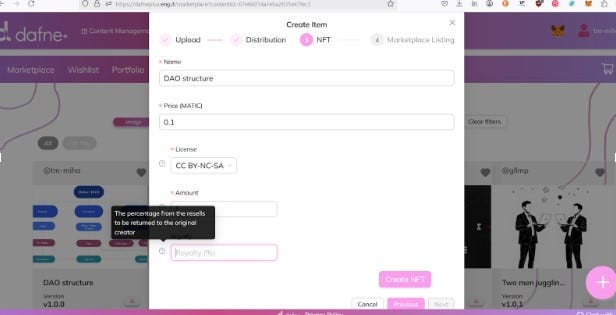
On the technological front, DAFNE+ developed a comprehensive ecosystem for digital content creation, distribution, and governance. The Content Management + DAO Infrastructure was designed to support communities seeking autonomous control over their creative assets, enabling digital asset registration, contributor attribution, and automated revenue sharing.
A modular and interoperable marketplace engine complements this by enabling secure asset listing, transaction facilitation, and NFT-based exchange, enhanced by license attribution, price-setting, and customizable terms of use.
Further enriching the platform, a suite of plugin-like tools integrates machine learning capabilities for applications such as music production and 3D pose estimation, fully compatible with the content management system.
Real-World Testing: Grounding Innovation in Creative Practice
Equally important to DAFNE+ was its commitment to testing in real-world contexts. The project implemented three pilot use cases, each involving a distinct yet complementary creative community.
- The first pilot, conducted with students from Manchester Metropolitan University’s School of Digital Arts and UPM, focused on cultural heritage and digital arts. These creators were selected for their collaborative workflows and diverse outputs — ranging from video and sound to XR.
- The second pilot, coordinated by IRCAM, engaged sound and music professionals, including artists, engineers, and researchers. This group was chosen for their use of advanced technologies and their need for precise attribution and provenance.
- The third pilot, led by Fab Lab Barcelona | IAAC, worked with open-source designers, makers, and students from global networks such as the Distributed Design Platform and the Maker Movement — whose practices emphasize remixing, sharing, and community-driven innovation.
Each pilot offered a unique environment to validate the platform’s flexibility, usability, and value proposition, ensuring that its features responded to real user needs.
Fab City Foundation’s Role: Advancing Ecosystemic Innovation and Distributed Design Sustainability
The Fab City Foundation (FCF) contributed to DAFNE+ as part of its long-term mission to enable cities to become locally productive and globally connected by 2054. Central to this mission is the Fab City Full Stack, a framework supporting the shift from extractive production models to circular, data-driven systems based on “Data In — Data Out” (DIDO) principles.
DAFNE+ aligned with the infrastructure and governance layers of this stack, providing an opportunity to test decentralized tools that promote transparency, openness, and fair value distribution.
FCF integrated its distributed design principles into the project’s development and testing phases, conducting workshops, interviews, and surveys with makers, designers, and educators. These activities informed key elements of the platform, including:
- Co-ownership and collaborative attribution models
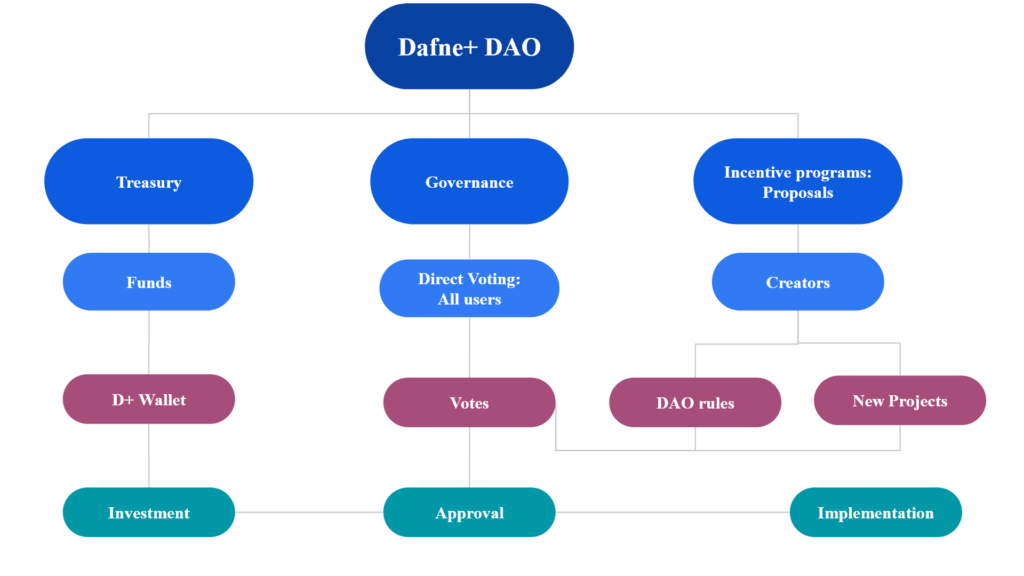
- DAO structure and governance logic
- Fair pricing models and legal considerations
- Monetization strategies, consolidated in the DAFNE+ business plan
FCF’s input also helped identify challenges to adoption, such as legal uncertainties and UX complexity, while estimating implementation costs for future decentralized infrastructures aligned with the Fab City vision.
By combining conceptual frameworks with practical fieldwork, FCF ensured that the platform was not only technically viable but socially and economically relevant, particularly in domains such as education, urban innovation, and distributed manufacturing.
Conclusion: A Foundation for the Future of Creative Platforms
The DAFNE+ project demonstrated that decentralized infrastructures can offer viable alternatives for digital content distribution, when designed with ethical values, technical flexibility, and community engagement at their core.
Through a combination of research, development, and real-world validation, the consortium co-developed a modular, open-source platform that empowers creators and communities with tools for governance, attribution, and value exchange. The project highlighted both opportunities for innovation and areas requiring further refinement, such as legal compliance, UX simplification, and adaptive governance models.
Rather than viewing these challenges as setbacks, DAFNE+ treated them as strategic signals, leading to an integrated business model capable of addressing key dimensions like legal risk, financial sustainability, and platform governance. The resulting DAFNE+ Platform Business Plan (D6.2) outlines four monetization strategies, transaction fees, revenue sharing, premium tools/subscriptions, and token-based incentives — alongside a go-to-market roadmap, risk assessment, and financial forecast.
By leveraging Ethereum and Polygon testnets, the project enabled secure, low-risk experimentation while maintaining compatibility with future mainnet deployment. This technical foundation, combined with community-driven governance mechanisms and support for a spectrum of licensing models (from open to proprietary), ensures a flexible and future-proof infrastructure.
In this sense, DAFNE+ is more than a technological prototype: it is a living blueprint for ethical, user-centered digital platforms. Its outputs, from code to governance models, will continue to support further experimentation, adoption, and scaling beyond the project’s funded timeline.
As the legal, social, and technological landscapes around blockchain continue to evolve, DAFNE+ stands as a timely contribution to rethinking how value, ownership, and collaboration can be organized in the digital age.
*This article was originally published on Medium.com