
The Interfacer platform is supporting existing communities across the value chain of distributed design and sustainable local manufacturing with a sovereign digital infrastructure
Since 2022, the Fab City Foundation has supported the Interfacer project with outreach activities within the Fab City Global Initiative by raising awareness and gathering expert insights through round table discussions and working groups. This article provides information about the Interfacer platform, its benefits, and the progress made. It also explains how communities can use and engage with the platform.
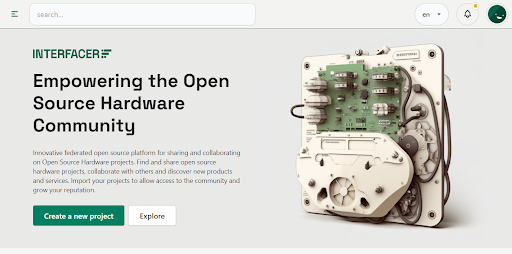
Interfacer is an European Union funded project aimed at building an open-source digital infrastructure as a federated network. This digital infrastructure, called the Interfacer platform (aka Fab City OS Core), connects makers, Fab Labs and small and medium enterprises (SMEs) to collaborate on their ideas on the whole value chain, from design to production.
Watch this brief video presentation by Dyne.org for an insightful overview of the Interfacer project and platform.
What is the Interfacer platform?
Interfacer platform is one of the outcomes of the Interfacer project, proposing an open source solution for sharing and collaborating on Open Source Hardware projects. It offers data sovereignty for the users, captures the value creation throughout the whole design and manufacturing lifecycle and facilitates finding partners and peers for further product development and cooperation.
What are the benefits of the platform?
Makers can use Interfacer to share and collaborate on their designs, and connect with other Fab Labs and SMEs who offer services to convert the designs into products.
Designs, products, and services are the three types of projects that can be created on our platform. A design is a documented plan or schematic for making a product, while a product is a physical item made according to a design. Services include manufacturing (3D-printing, cutting, digital and traditional craftsmanship etc.) help with product design or training aimed at assisting designers to bring their ideas to life.
Additionally, users can browse a map to look for projects in their surrounding, or search and discover projects on the platform based on search criteria, such as tags, users, location.
The Interfacer Platform has many unique features, including the Digital Product Passport, a W3C-DID identity service and the economic model “Creative Flows”.
Digital Product Passport (DPP)
Digital Product Passport is a structured product related information, including data on sustainability to facilitate circular value retention and extraction activities such as reuse, remanufacturing and repairing.
Stored into a distributed ledger, it guarantees reliable and authentic information, helping to reduce production costs and bureaucracy.
DPP will also record design’s flows and development data to promote global collaboration, providing stronger motivations and opportunities to new contributors.
The DPP will add valuable data for recycling, disassembly and repair to improve sustainability and green practices.
Explore further details about the DPP here.
W3C-DID
The W3C DID standard defines a way to create and manage decentralised identifiers (DIDs) for entities such as people, organisations, devices, etc. on a blockchain or other decentralised systems. It empowers digital sovereignty and federated cooperation.
The DIDs contain strictly non-sensitive data, in full compliance with the GDPR directive. You can browse the existing DIDs using the DID explorer.
Full information can be read here via dyne.org Foundation.
Creative Flows
Fab City OS core presents a revolutionary economic model, called Creative Flows, supporting the sharing, tracking, and tracing of open hardware in a standardised form.
This enhances collaboration and promotes fair agreements directly between users in a secure network. Globally connected productive communities are empowered to discover, remix, and improve designs and technologies like never before.
Creative Flows, uses blockchain technology, facilitates fair revenue distribution based on contributions and agreements. Fab City OS will transform the traditional economic model, offering a decentralised and equitable solution. Details can be read here.
How does the Interfacer platform work?
Creating and setting up a profile on the platform is a matter of seconds, as it is adding new and existing projects, by importing from other sources like GitHub, GitLab and Losh.
The idea is not to substitute project hosting service providers. Instead, it aims to complement the project information by adding cryptographically signed data. This data supports specific standard implementations for open-source hardware (OSH), facilitating filtering, data exchange, and automation.
Additionally, it includes information about contributors, recycling patterns, existing certificates, and more. This approach offers an immediate tool for sharing information through an initial DPP implementation, which can be accessed via a QR code.
Credit: Dyne.org
How was the Interfacer platform developed?
In early 2022, we initiated the Interfacer project and started to develop the first mock-ups which led to the beta release milestone during the Interfacer project final event. Drawing upon our experience from flagship EU projects like Decode and Reflow, we incorporated components such as the cryptographic stack based on Zenroom and the Digital Product Passport.
Throughout user interviews, we discovered that the open-source hardware (OSH) context is complex, involving diverse actors like artisans, DIY enthusiasts, and innovative startups seeking ethical business models.
The community faces challenges spanning from the absence of structured information standards to licensing and responsibility issues between designers and manufacturers, as well as sustainability and compensation concerns.
Based on more than 20 years of experience with digital innovation and hackerspaces, we adopted an agile methodology and kicked off a co-design process, with monthly sessions, involving multiple stakeholders, like the Hamburg community, the Reflow community, Interfacer colleagues and Helmut Schmidt University researchers.
Our approach emphasises openness enabling anyone to provide feedback, make feature requests, and report issues.
Connection to Fab City Full Stack
Ultimately, the Interfacer platform may help cities, regions and communities in meeting the Fab City challenge: to produce (almost) everything they consume locally while sharing knowledge globally. In the context of the Fab City Full Stack, a framework that helps cities and communities interpret and implement this challenge, the process of knowledge exchange is crucial to Fab City’s overall success. The development and implementation of new technologies, processes, and business models is necessary to support knowledge exchange and collaboration across local and global networks.
The Interfacer platform puts into action the Fab City Full Stack specifically, Layer 7 — Sharing knowledge with global networks. More information on the full stack is available here.
What is the promise of the platform for the future?
We are only at the beginning of a new approach towards global collaboration and further research. Trials and testing will be needed in order to address tensions between local diverse multi-disciplines and global system thinking, between Do it Yourself (DIY) culture and standards adoption, need for interoperability and data exchange, including the tensions between a fair value distribution and the accumulation tendencies now in place, just to name a few.
In the next period we are investing in keeping the platform alive, facilitating onboarding and adoption with a series of webinars, monitoring the legal framework for the related topics, identifying new use-cases and further funding that can allow us to maintain the existing infrastructure and build new features.
The most interesting directions that we foresee are:
- Deploying multiple federated instances where one city or any other similar entity can run its own instance, set its own rules and manage effort, motivation and compensation
- Work on converting the creative flow points now expressed in NFT into fungible tokens.
- Collect initial data sets for the DPP that can facilitate environmental cost measurements, recycling and repairing practices and identification of weaknesses and dependencies in the supply — chain.
It is quite obvious that these are goals for more than a single organisation, and that we may only stand a chance to scale the solution with support from the global community.
We invite you to try the platform and join our hands-on live webinars and contribute your insights on how we can further progress together.
Join this process by expressing your interest on our bridged chat channel (pick your favorite chat provider between
Telegram https://socials.dyne.org/telegram-interfacer , Discord https://socials.dyne.org/discord-interfacer or Matrix https://socials.dyne.org/matrix-interfacer), or visit the follow-up website by dyne.org: https://interfacerproject.dyne.org/interfacer-project/
Fab City OS Core is Online
Visit the platform → interfacer.dyne.org
*This article was originally published on Medium.com